BINGO
Computes the scalar power spectrum, bispectrum and fNL for arbitrary triangular configurations in canonical single-field inflation.
Public / Fortran 90Open dossier →
Computational notebook
Cosmological scales
Cosmology has one observable Universe. We see it at many wavelengths, resolutions, directions and look-back times—not through repeatable experiments.
Redshift z measures the stretching of light by expansion: z = 0 here and now, while distant objects are seen at earlier epochs. Given the matter and dark-energy densities and H₀, the Friedmann equations map redshift into distance and age. The resulting history runs from inflation through radiation and matter domination to today’s accelerated expansion.
This makes numerical model comparison and model-independent reconstruction indispensable partners. The tools below solve theories, reconstruct signals and connect them to observations.
For MSc & PhD students
Friedmann equations; compute the age of the Universe.
Open notebook ↗02Expansion rate; age at redshift z; comoving, angular-diameter and luminosity distances; cosmic acceleration.
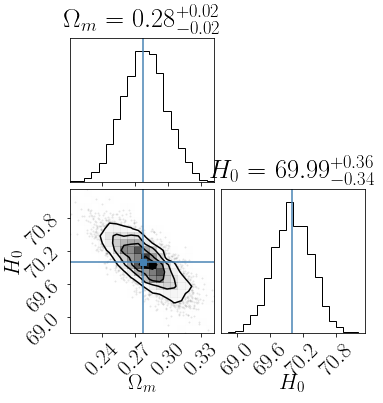
Open notebook ↗03Supernovae; distance modulus; χ²; best fit; Markov-chain Monte Carlo and parameter constraints.
Open notebook ↗04Variable equations of state; scalar fields; CPL and decaying-dark-energy parametrizations; BAO, CMB summary statistics and inference.
Open notebook ↗05The tanh model; optical depth; neutral hydrogen; CMB signatures and constraints.
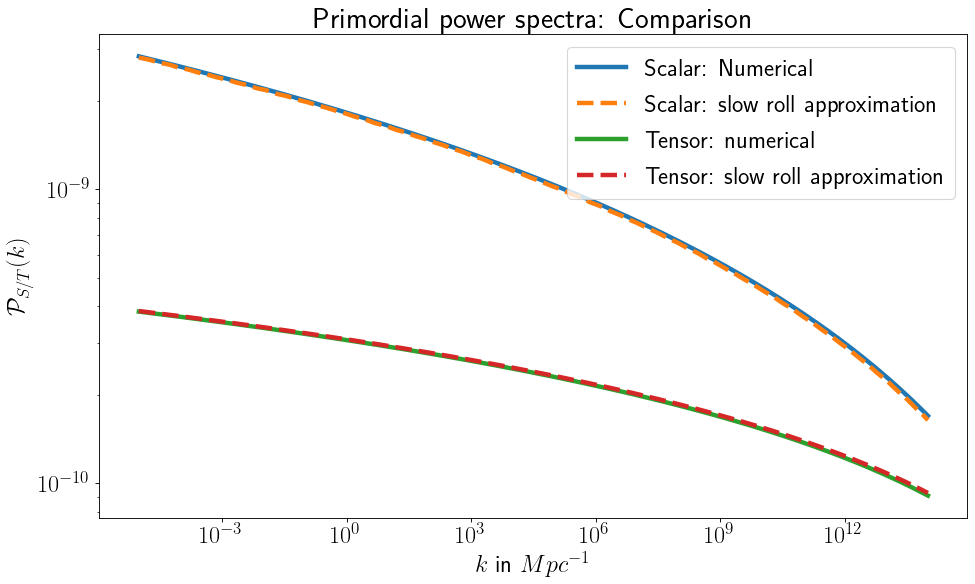
Open notebook ↗06Horizon problem; Klein–Gordon and Mukhanov–Sasaki equations; scalar and tensor spectra; slow-roll comparison.
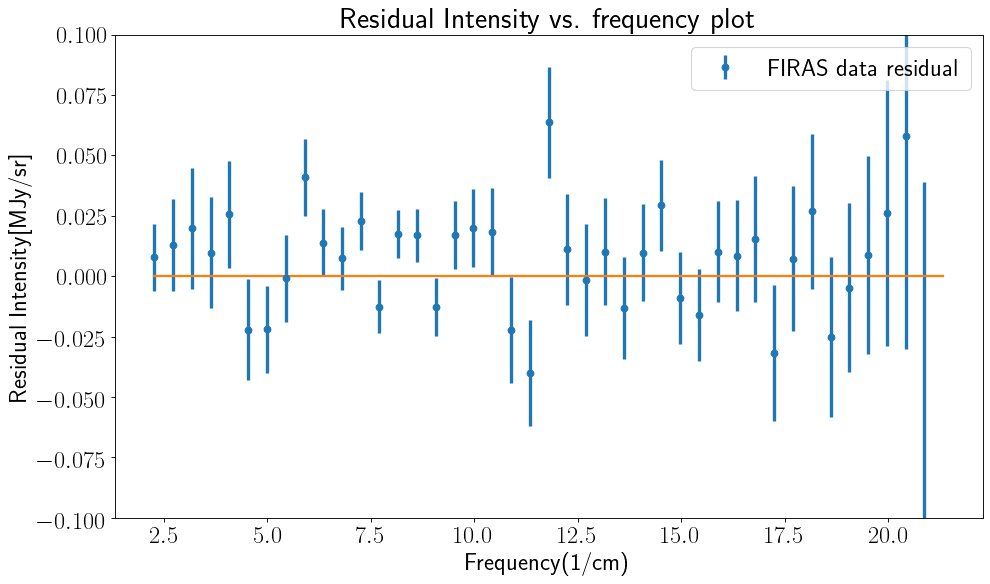
Open notebook ↗07Fit the CMB monopole and constrain spectral distortions using FIRAS data.
Open notebook ↗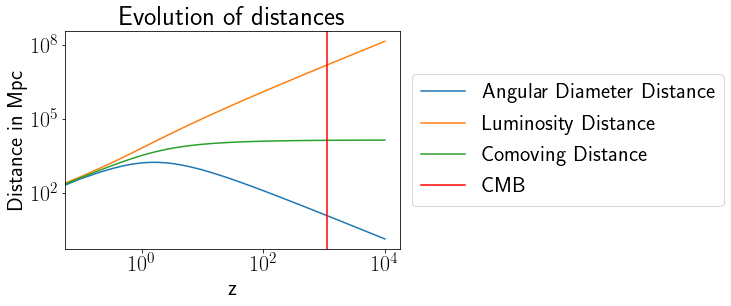
Research software
Computes the scalar power spectrum, bispectrum and fNL for arbitrary triangular configurations in canonical single-field inflation.
Exact primordial spectra for canonical and non-canonical single-field models, two-field isocurvature and correlation spectra, and tensor modes; used as a CosmoMC add-on.
Number density and formation rates of dark-matter halos for arbitrary inflationary potentials using Press–Schechter and Sheth–Tormen formalisms.
Primordial-black-hole abundance and the stochastic gravitational-wave background generated by enhanced small-scale primordial power.
A 3D dark-matter fluid simulation in a horizon-size box, developed with Stephen Appleby.
Continuum estimation in redshifted quasar spectra for extracting neutral-hydrogen absorption and flux correlations.
Reionization optical depth from a nonlinear matter-density field; developed for work on Lyman-α constraints.
A nine-compartment, age-stratified and migration-linked model used in a published district-to-national analysis of India’s first COVID-19 wave.
Theory constructions
A family of inflationary potentials producing large-scale suppression and localized oscillations supported in parts of the Planck likelihood. The framework followed Whipped Inflation and has been tested against CMB and LSS forecasts.
A flexible, physical history constructed from free-electron fractions at selected redshifts and polynomial interpolation. It was introduced with Planck 2015 constraints and adapted in the Planck 2018 reionization analysis.
A free-form solution of ionization equations in which source and sink terms are inferred jointly from CMB, UV-luminosity-density and neutral-hydrogen data. The reconstruction finds a duration near three redshift units and constrains recombination timescales.
Inverse problems
Extends deconvolution of the primordial spectrum to combined binned and unbinned CMB spectra, including foreground and lensing effects; supplied as CAMB and CosmoMC add-ons.
Locates broad features with a compact set of flexible bins. Applied to Planck, it showed where the data require a red spectral tilt.
Uses the auto- and cross-bispectra of Lyman-α transmitted flux and post-reionization 21 cm signal to constrain primordial non-Gaussianity.
Tests cosmic isotropy in the matter-dominated epoch using moments of the transmitted-flux distribution in BOSS DR9 sky patches.