Upcoming · second edition
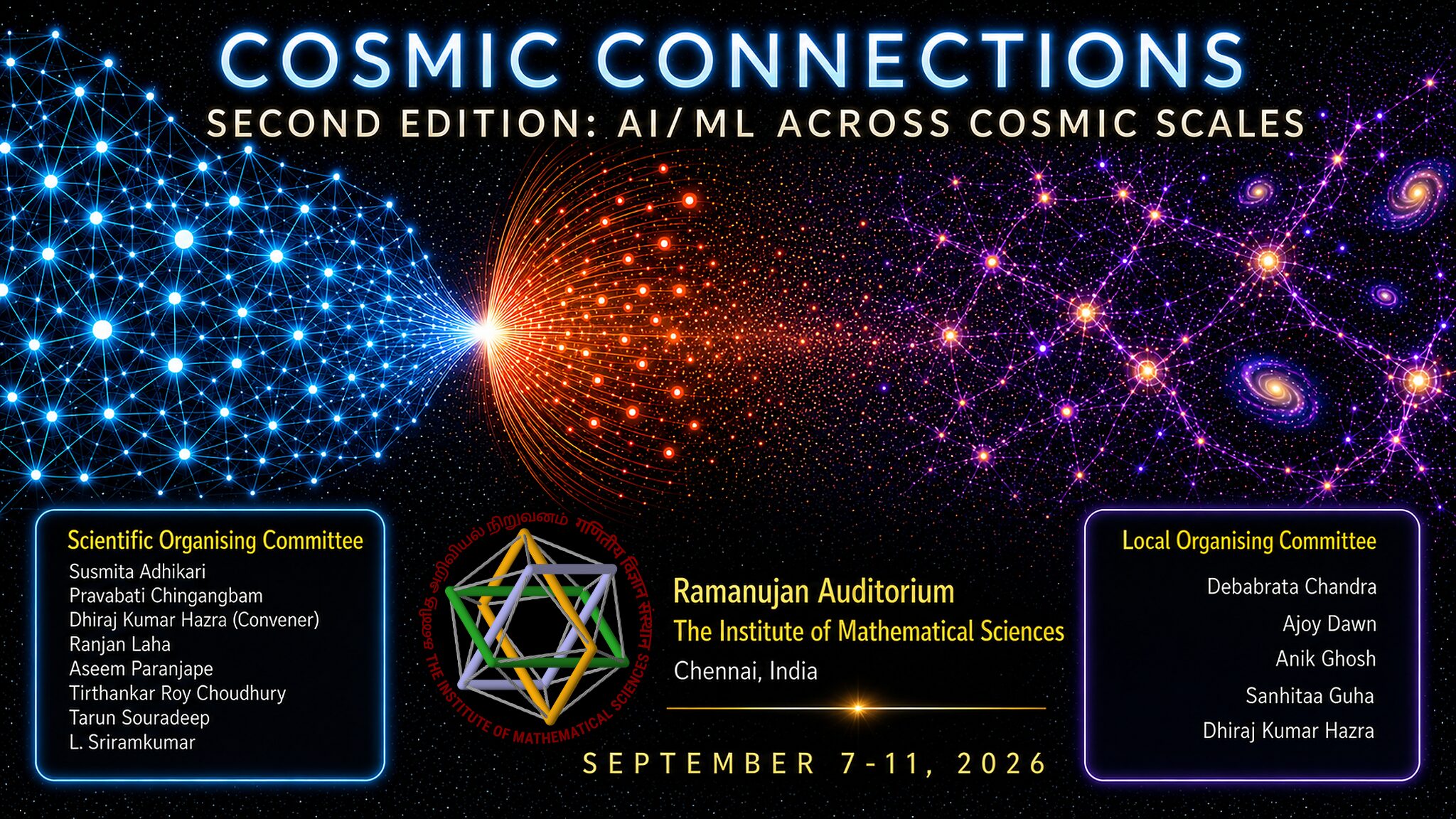
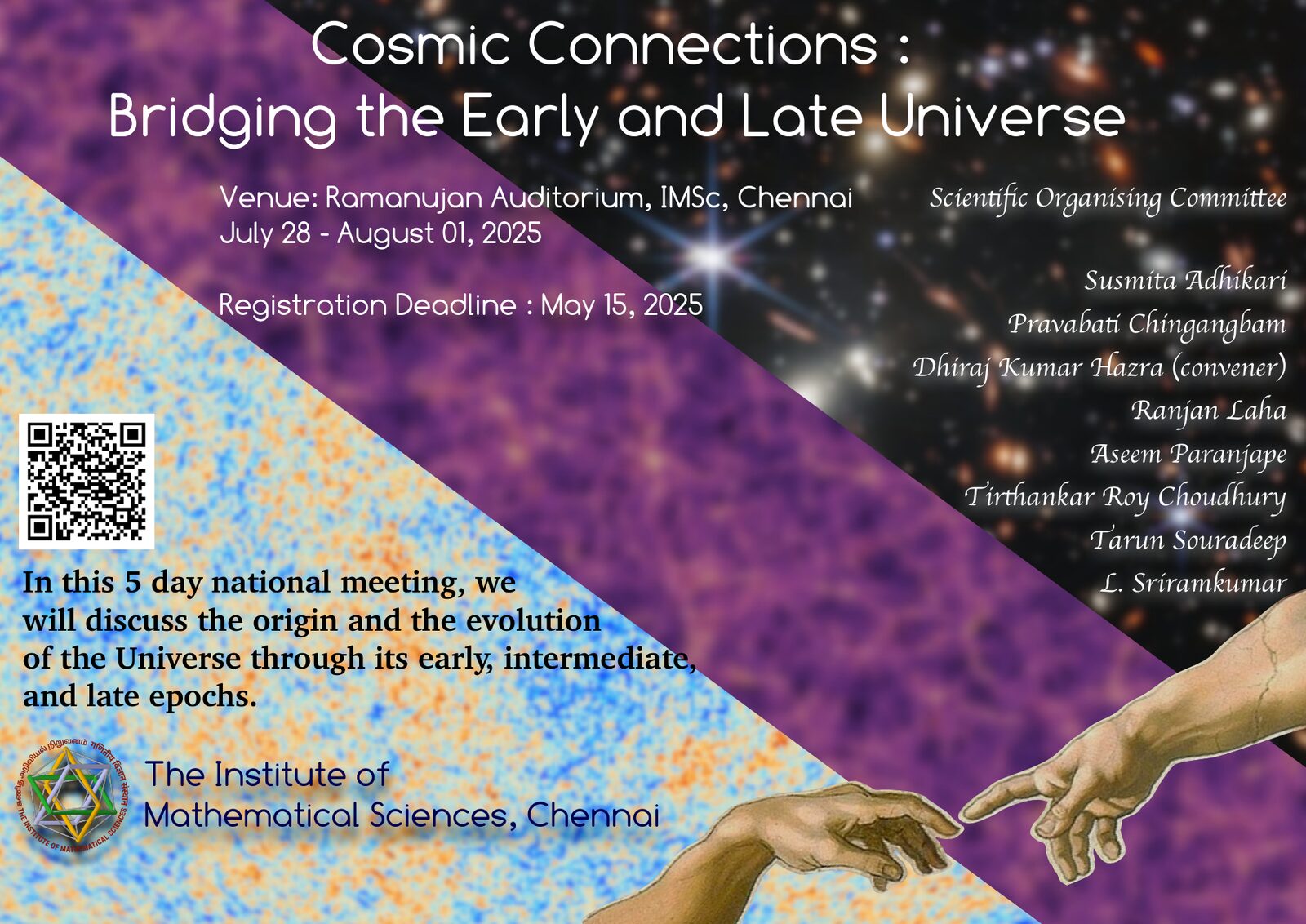
Cosmic Connections 2026
AI/ML across cosmic scales
- Dates
- 7–11 September 2026
- Venue
- IMSc, Chennai
- Format
- In person
The second national Cosmic Connections meeting brings researchers in cosmology from across India together around the growing role of artificial intelligence and machine learning, while retaining a broad view of the early, intermediate and late Universe.
Programme structure
Conference · 7–9 September. Inflation, primordial perturbations, CMB and gravitational waves; dark ages, cosmic dawn, reionization and JWST; dark energy, large-scale structure, surveys, Lyman-α, 21 cm cosmology and tensions.
Workshop · 10–11 September. Hands-on sessions in simulation-based inference, neural and convolutional networks, Bayesian tools, survey science and theoretical modelling.
The meeting is intended for PhD students, postdoctoral researchers and faculty. Registration closes 25 July 2026.
Conference talks and speakers
Early Universe
- Suddhasattwa Brahma
From Hidden Symmetries to Thermal Seeds: Open Quantum Dynamics during Inflation
- H. V. Ragavendra
Exploring primordial dynamics using cosmological gravitational wave
- Aurindam Mondal
Quantum Measures of Early Universe cosmology: Investigation of Bell inequality for squeezed coherent state of inflationary perturbations
- Koushik Dutta
Scalaron Dark Matter Dynamics in f(R) Gravity
- Nilanjandev Bhaumik
Population of near-solar-mass primordial black holes in LVK and NANOGrav
- Rounak Nath
Constraints on the inflationary vacuum and reheating era from NANOGrav
- Prabhav Singh
Signatures of Primordial Black Hole Induced Neutrinos in the Universe
- Gokhula Prasad
Bound State dark matter in the Early Universe: Solving the Cosmological Tensions
- Bhargabi Saha
Warm α-Attractor Inflation: Dynamics and Observational Viability
- Debabrata Chandra
Reconstructing Primordial Power Spectrum for Widest Scales from CMB
Intermediate Universe
- Namrata Roy
From Black Holes to the Cosmic Baryon Cycle: Mapping Feedback Across Cosmic Scales across Cosmic Time
- Jaya Doliya
Dark Recipe for the First Giants
- Pralay Biswas
Insights from the Previously Unseen Low-mass HST-dark Galaxies with JWST/UNCOVER
- Anshuman Tripathi
Bridging Galaxy Evolution and the 21-cm Signal through Joint Machine Learning Constraints on the Epoch of Reionization
- Abhirup Datta
Low-Frequency Radio Cosmology with the SKA
- Suchetana Chatterjee
Black Holes in the Cosmic Web
- Shikhar Mittal
Probing Interacting Dark Matter with the SARAS3 21-cm Cosmic Dawn Non-Detection
- Ranjini Mondal
Dark Secrets of Baryons: Illuminating Dark Matter-Baryon Interactions with JWST
- Anirban Chowdhary
Conditional Luminosity Functions of Active Galactic Nuclei in Simulations
- Hiten
Primordial Magnetic Fields and Early Structure Formation: Implications for the High-Redshift 21 cm Signal
- Manpreet Singh
Constraining the Neutral Hydrogen Fraction across Different Reionization Histories using Lyman Alpha Dark Gap Statistics
- Shiriny Akthar
Probing the End of Reionization with 21cm–[CII] Cross-Correlation
- Anoop Krishna
HaloFieldNet: Emulating Halo Source Fields for 21-cm Reionization
- Yashrajsinh Mahida
Emulating 21-cm Reionisation Signal Maps and Their Summary Statistics
- Mayukh Mandal
Seeing Through the Foregrounds: Bayesian Inference and Signal Reconstruction for the EoR 21-cm Signal
- Bhuwan Joshi
Constraining Lorentz Violation using 21cm and CMB Cross Correlations
- Mayuri S. Rao
The First Light, First Atoms, First Stars — An experimental perspective
- Harsh Mehta
Insights into JWST observations using the Oldest Cosmic Light
- Anirban Chakraborty
Understanding the Properties of Reionization-Era Galaxies in the JWST Era
Late Universe
- Sharvari Nadkarni-Ghosh
Approximate methods to model non-linear large scale structure
- Rahul Shah
AI/ML Techniques for Model-Independent Cosmological Analysis
- Joseph P. J.
Kernel dependence of the Gaussian Process reconstruction of late Universe expansion history
- Vikhyat Sharma
N-body Simulations of cosmologies with Light Massive Relics
- Saptarshi Sarkar
Reconciling large-scale Lyman-alpha correlations with the SCRIPT Semi-numerical Model
- Priyanka Singh
Velocity Reconstruction for kSZ effect across Baryonic Feedback Mode
- Masroor Bashir
The CatWISE2020 Quasar Dipole: A Reassessment of the Cosmic Dipole Anomaly
- Manas Mohit Dosibhatla
Tracing Cosmic Web Morphology with SKA-Mid 21-cm and CO Line Intensity Mapping Surveys
- Durba Ghosh
Probing Dark Matter–Baryon Interactions with Line Intensity Mapping: Forecasts for COMAP-EoR and COMAP-ERA
- Animesh Maji
Fantastic Beasts and where to find them: The population of Black Hole–Luminous Companion binaries in different galaxy environments
- Tulip Ray
Dark Matter Halo Dynamics in Yukawa Modified Gravity: From Spherical Collapse to the Splashback Radius
- Dhiraj Kuniyal
An insight to Hubble Tension from the non-interacting limit of interacting dark energy-matter
- Priyanka Saha
A Systematic Comparison of Quasi-Static and Subhorizon Approximations in interacting Dark Energy Cosmologies
- Sayantan Ghosh
Reconstructing Dirac-Born-Infeld Dark Energy From Dynamical System to Gaussian Process
- Jatin Kumar
A Hybrid Box Approach for Identifying High Resolution Halos
- Rinchen Sherpa
Semi analytic subhalo mass functions for dark matter baryon scattering
- S. Shankaranarayanan
The Memory of the Universe: A Purely Gravitational Probe for Cosmological Tensions
- Roshna K.
Constraining flat ΛCDM model using Jackknife and Bootstrap resampling
- Ujjwal Kumar Upadhyay
Can Distance Duality Violation Save Late-time Solutions to the Hubble Tension?
- Yash Koushal
Cosmological N-Body Simulations of Dissipative Self-Interacting Dark Matter
- Siddhant Sen
One Halo, Two Boundaries: Relating Accretion Shocks and Splashback Radii in Galaxy Clusters
- Suchira Sarkar
Exploring the local universe galaxy populations using 4MOST Hemisphere survey & application of machine learning
Advanced workshop lecturers and topics
- Tirthankar Roy Choudhury
Reionization: parameter inference using SBI
- Suman Majumdar · TA: Yashrajsinh Mahida
Emulators for the cosmic 21-cm signal
- Madhurima Choudhury
Recovering 21cm signal and parameters from simulated radio-interferometric datasets
- Shadab Alam
AI/ML and inference with large-scale structure
- Soumak Maitra
ML for cosmological fields
- Debabrata Adak
AI/ML for CMB data analysis