Initialize
Set population, age groups, group fractions, compartment transitions and runtime constants.
Interdisciplinary model · INDSCI-SIM
Extended, zone-Linked
nine-compartment SIR
A COVID-19 simulation with nine disease compartments, age-stratified contacts, policy transitions, migration and Bayesian parameter estimation—used from district to national scales.
Model anatomy
ELiXSIR solves an extended SEIR system with nine compartments, age-dependent contact patterns and migration between zones. The framework allows different intervention scenarios to be studied. Migration may be coupled through a gravity prescription or a more generic connection structure.
The code was developed within the INDSCI-SIM collaboration, which provided scientific inputs during the Indian COVID-19 response, and integrates directly with samplers for parameter estimation. Its published application covered Karnataka districts and state, five major cities, and India as a whole—not Delhi alone.
Read the PLOS Computational Biology paper ↗Figures from the source


Analysis pipeline
Set population, age groups, group fractions, compartment transitions and runtime constants.
Use policy dates to switch contact matrices between lockdown and unlock regimes; model migration with a gravity or generic structure.
Supply priors, starting points, proposal widths and daily infection/death data; run CosmoChord samples through ELiXSIR over MPI.
Generate infections and deaths, evolve reporting bias, compare scaled infections and predicted deaths with reported series.
Use GetDist for posterior distributions, then pass posterior samples back through ELiXSIR to obtain time-series bounds.
Published application
Serosurvey-calibrated estimates of infection and death undercounting.
Joint fits to infections and deaths with uncertainty bands.
Bengaluru, Chennai, Delhi, Mumbai and Pune, each with distinct epidemic structure.
A nationwide first-wave reconstruction with inferred infections and reporting bias.
Inferred total infections, infection fatality ratio and the evolving reproduction number R(t).
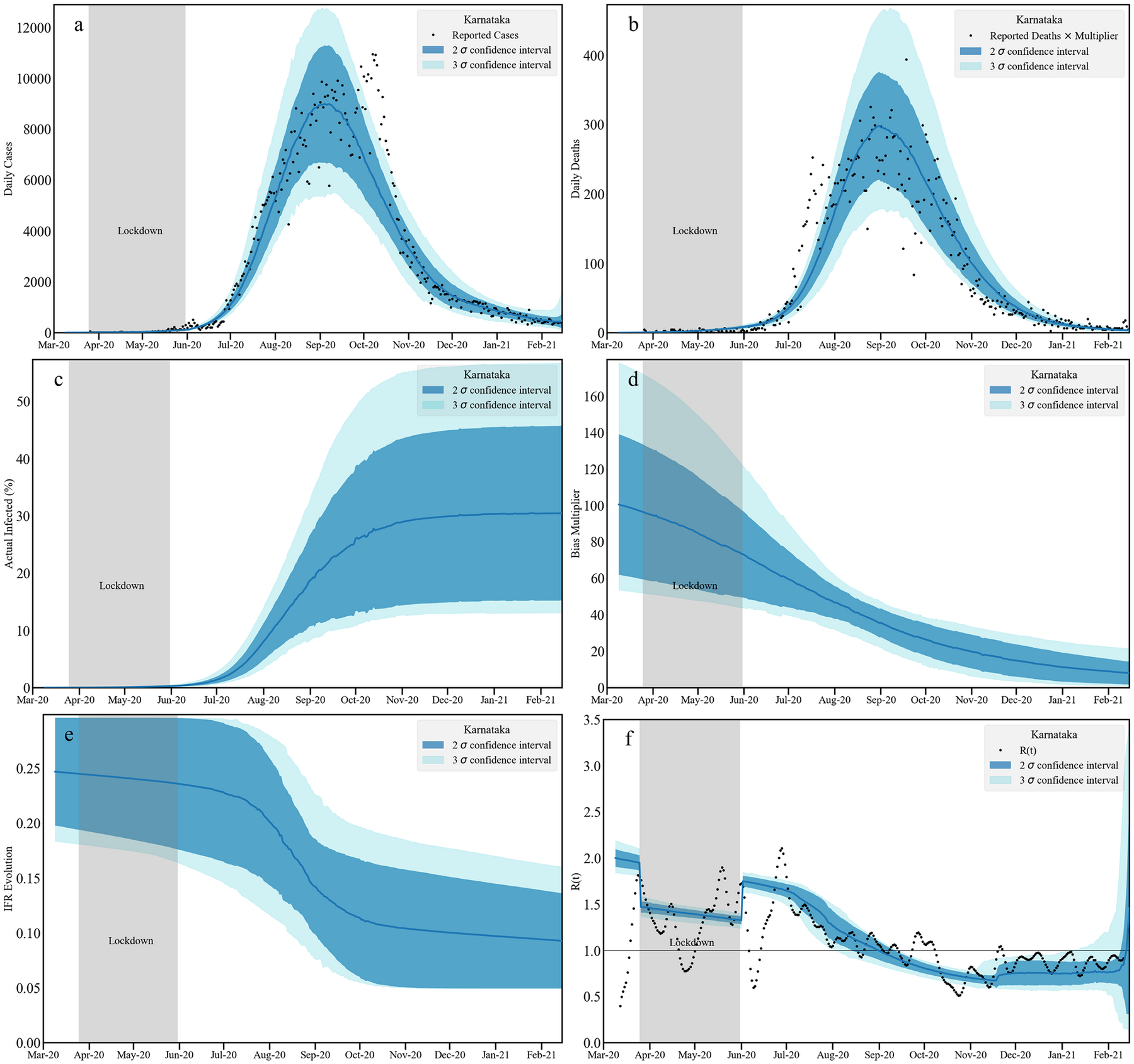
Reported cases and deaths are fitted jointly; posterior samples then recover inferred total infections, reporting bias, the infection fatality ratio and R(t).
Read the paper and figure source ↗